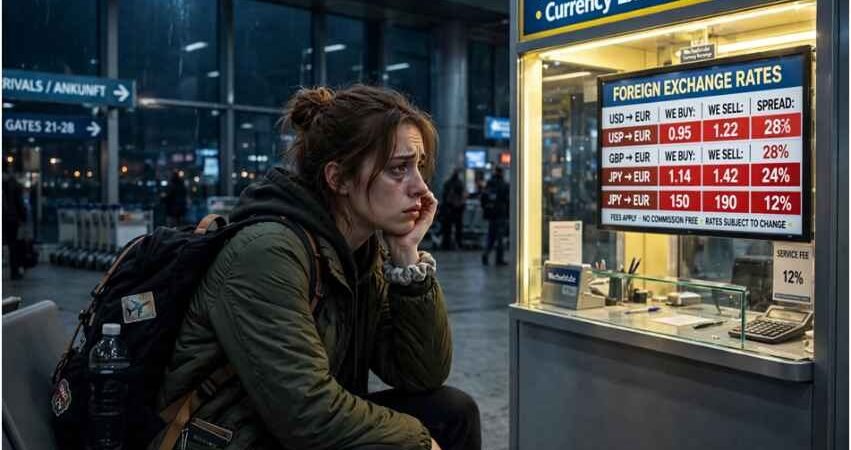
Landing in a foreign terminal exhausted after a twelve-hour flight is usually when expensive mistakes happen. I learned this years ago in Rome, watching an airport currency booth siphon a 14% margin off my travel cash simply because I was too tired to think critically. Learning how to manage money and exchange currency while traveling is the single fastest way to protect your trip savings from insidious banking charges, predatory exchange kiosks, and merchant markups.
The Pre-Departure Financial Setup (Before You Fly)
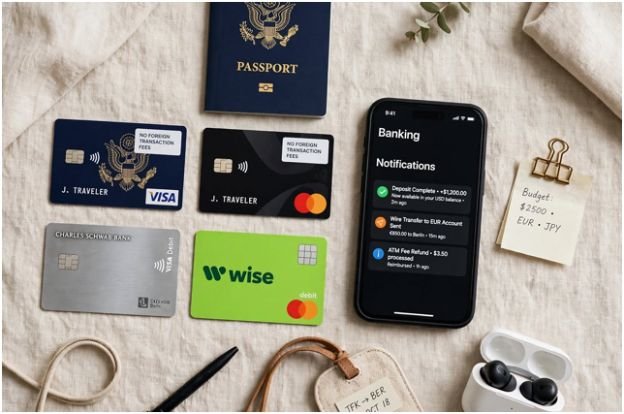
Financial headaches abroad almost always originate at home. Before packing your bags, establish a reliable card infrastructure that bypasses unnecessary overhead. Audit your current cards, open an account with international ATM fee refunds, configure digital multi-currency wallets, and toggle real-time notifications on your banking apps.
Auditing Cards for Foreign Transaction Fees
Most standard credit cards quietly add a 3% foreign transaction fee to every swipe made outside the United States. That turns a $3,000 international vacation into a $90 donation to your card issuer.
I carry primary and secondary credit cards operating on separate payment networks (one Visa, one Mastercard) that explicitly charge zero foreign transaction fees.
The Consumer Financial Protection Bureau (CFPB) emphasizes that credit cards offer vastly superior fraud defense compared to debit cards under federal regulation.
If a vendor skims your credit card in a night market, the bank’s capital is locked up during an investigation—not the money you need for tomorrow’s hotel bill.
Multi-Currency Digital Wallets vs. Traditional Checking
If you prefer debit spending, pairing an established travel checking account with a fintech multi-currency card is the gold standard.
Accounts from providers like Charles Schwab Bank offer unlimited worldwide ATM fee rebates, reimbursing local terminal surcharges automatically at the end of each billing cycle. Alongside this, services like Wise allow you to hold balances across dozens of currencies at the real mid-market exchange rate.
You can convert funds during market hours, hold the balance in local tender, and spend without unexpected exchange fluctuations when you base yourself for regional exploration across multiple borders.
How to Exchange Currency Without Predatory Markups
Physical cash exchange has shifted from a necessary travel ritual into an aggressive retail trap. Here is how to keep conversion spreads as close to zero as possible.
Dodging the Airport Kiosk Trap
Airport exchange booths and hotel front desks rely on captive audiences. They lure tired travelers with signs screaming “Zero Percent Commission,” yet embed a 10% to 15% spread within their proprietary conversion rates.
Unless you are arriving at an unusual border post that requires physical payment for an entry visa, never exchange money at the airport. If you genuinely want peace of mind, order $50 to $100 in destination currency through your local home bank branch a week before departure. For everything else, bank ATMs in the destination city remain your most cost-effective source of cash.
The DCC Trap: Why You Must Always Choose Local Currency
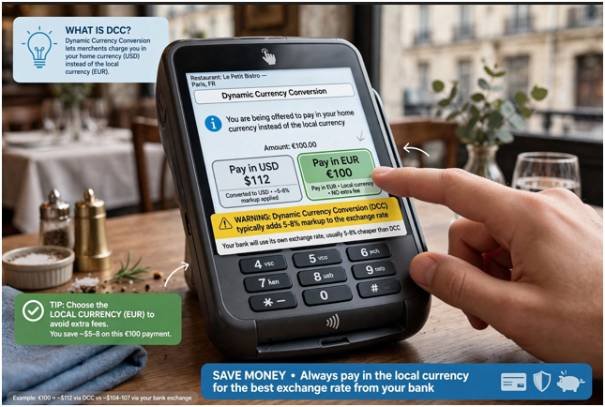
When paying for dinner or pulling cash abroad, the payment terminal will frequently display a polite prompt: “Would you like to be billed in USD or the local currency?”
Always decline and select the local currency.
This prompt triggers Dynamic Currency Conversion (DCC). Selecting US dollars authorizes the merchant’s foreign payment gateway to establish an arbitrary, heavily marked-up conversion rate—often adding 5% to 8% above the mid-market figure.
Choosing the local currency forces the transaction through Visa or Mastercard’s wholesale interbank rate, which is virtually identical to live institutional prices.
On-the-Ground Cash and Card Management Strategies
Once your plane touches the tarmac, execution matters just as much as preparation. Carry your primary cards securely, isolate your reserves in your room safe, and keep encrypted digital tokens stored on your mobile device as an emergency backup.
Bank-Branch ATMs vs. Standalone Tourist Terminals
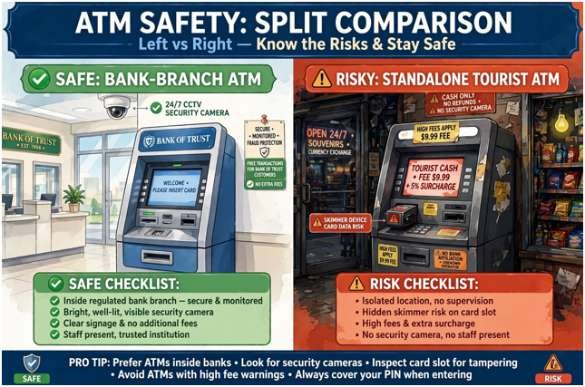
Not all automated teller machines operate equally. Independent, standalone kiosks placed in tourist strips, convenience stores, and nightlife districts often charge predatory terminal fees and carry elevated risks of physical skimmers.
Only withdraw local cash from ATMs directly attached to or physically situated inside reputable retail banking institutions. Bank-branch ATMs are subject to tighter regulatory oversight, display terminal surcharges clearly before dispensing, and feature surveillance that discourages card tampering.
If a machine ever malfunctions or swallows your card, resolving the issue with an on-duty bank manager inside is far simpler than chasing a customer service hotline for an unbranded kiosk.
Physical Redundancy: The Three-Tier Travel Wallet
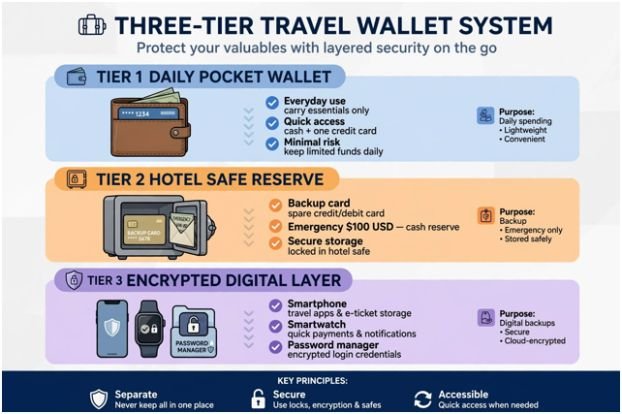
Losing your sole financial card abroad can ruin a trip in minutes. I divide my physical instruments across three independent tiers:
- Daily Pocket Wallet: Houses a single no-foreign-fee credit card and enough cash for street markets, public transit, and casual dining.
- Hotel Safe Reserve: Contains an alternate credit card on a different processing network, an ATM-only debit card, and an emergency stash of $100 in crisp, undamaged US currency.
- Encrypted Digital Layer: Digital wallet passes loaded on my phone and smartwatch, backed by an encrypted password-manager vault holding contact numbers for my bank’s international fraud division.
Real-World Cost Breakdown: Why Small Margins Matter
To illustrate how quickly financial leaks accumulate, consider spending the equivalent of $2,000 on overseas purchases alongside $500 in physical ATM cash withdrawals.
Relying on an airport exchange booth for this entire budget saddles you with a 10% to 15% currency markup, inflating your total expenditure to between $2,750 and $2,875.
Using an unoptimized domestic debit or credit card is equally damaging. Between standard 3% foreign transaction fees, out-of-network ATM terminal charges, and accepting Dynamic Currency Conversion at the point of sale, your real cost climbs to roughly $2,705 to $2,780.
By contrast, an optimized strategy combining a zero-FTF credit card and a fee-rebating bank ATM converts at the wholesale interbank rate. Your total cost sits right around $2,505 to $2,515. That simple distinction keeps roughly $250 to $350 in your pocket—enough to fund several nights of accommodation or a cross-country train pass.
Sassy Financial Survival: Pack Your Common Sense
Financial peace abroad doesn’t require an accounting degree; it simply demands you stop handing free margins to third-party processors.
Treat airport exchange desks like scenic backdrops to walk right past, refuse dynamic currency conversion whenever a machine offers to do the math for you, and never pull out your core domestic debit card at a street terminal.
Set your alerts, lock in fee-free cards, and let the banks fight over pennies while you enjoy your trip.
When you budget for a three month sabbatical trip or plan a quick two-week getaway, modern travel finance is no longer about traveler’s checks or carrying thick envelopes of cash. It requires a lean, tech-forward system that lets you pay like a local while keeping your domestic balances isolated from fraud.
Frequently Asked Questions
1. What is the cheapest way to exchange currency when traveling abroad?
Using a zero-fee debit card at an official local bank ATM in your destination provides the lowest conversion cost.
2. Why should I always pay in the local currency on credit card machines?
Paying in local currency avoids Dynamic Currency Conversion markups, which quietly inflate prices by 3% to 8%.
3. How much physical cash should I carry when traveling internationally?
Carry roughly $50 to $100 equivalent for emergencies and small vendors; charge the rest to a no-FTF credit card.
4. Are airport currency exchange booths ever worth using?
No, airport booths consistently charge the worst exchange rates and highest hidden spreads in the travel industry.