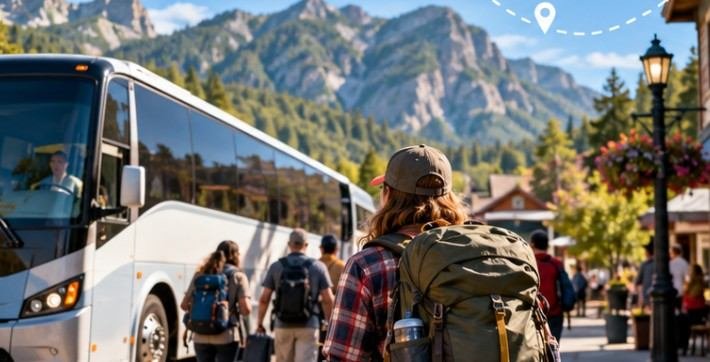
Here is what airline search screens hide: the United States already has substantial no-flight adventure infrastructure. In 2024, the National Park Service counted 96 transit systems across 58 parks and 32.6 million passenger boardings, including shuttles, buses, ferries and other modes. For travelers interested in adventure travel without flying, that changes the question from “How do I get there fastest?” to “How much of the journey can become part of the experience?”
That shift opens up overnight trains, ferry crossings, intercity buses, bicycle touring and overland road trips that would otherwise be treated as mere transportation.
Start With the Transportation Spine, Not the Destination
A successful no-flight trip usually has one main transportation “spine”: a train, ferry, bus route or self-powered trail that carries you most of the distance. The adventure is then built around stops and connections along it.
Rail works especially well when the destination has a usable final mile. The National Park Service notes that Amtrak reaches or passes near several park areas. Glacier National Park is a strong example: the Empire Builder stops year-round at West Glacier and Essex, with seasonal service at East Glacier Park. Summer connections can then link rail passengers with park destinations.
Harpers Ferry, West Virginia, offers a smaller-scale version. It has Amtrak service and direct access to the Appalachian Trail, allowing a rail arrival to become a hiking trip almost immediately.
Which No-Fly Mode Fits Your Trip?
| Mode | Best for | Main strength | Main limitation |
| Long-distance train | Parks, mountain towns, multi-day journeys | Rest while covering distance | Limited departures and delays |
| Ferry | Islands and coastal routes | Scenic transportation | Weather and seasonal schedules |
| Intercity bus | Budget regional travel | Broad city coverage | Less room for bulky gear |
| Bicycle touring | Trails and rural exploration | Maximum immersion | Fitness and weather demands |
| Road trip | Remote trailheads | Final-mile flexibility | Driving fatigue and fuel cost |
The goal is not to choose the most romantic mode. Choose the one whose schedule, baggage rules and arrival point support what you actually want to do outdoors.
Ferries Are More Useful Than Many Travelers Realize
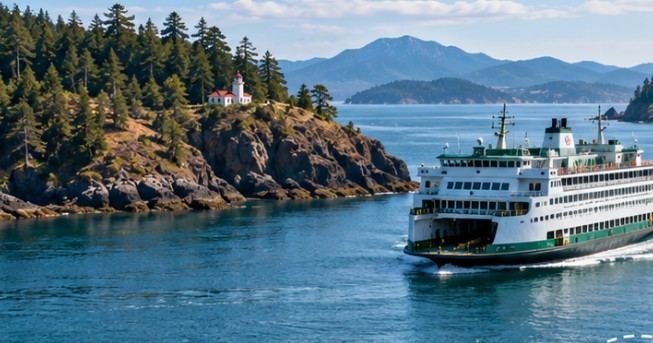
Ferry travel is not a fringe option in the United States. The Bureau of Transportation Statistics’ 2024 census reported 723 vessels, 575 terminals and 897 unique route segments among responding operators, with 105.8 million annual passenger trips reported.
That makes ferries useful for island hikes, coastal cycling and waterfront travel while sometimes eliminating long road detours. Washington, Alaska, New York and New England are obvious places to investigate, but ferry networks exist well beyond them.
Before booking, check seasonality, bicycle or vehicle reservation rules, and what happens if the final sailing is canceled.
Build a Rail-and-Trail Adventure
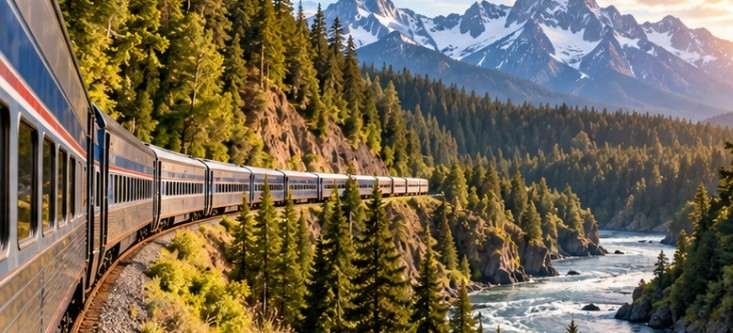
No-fly travel becomes more interesting when active travel is added to rail. Adventure Cycling Association reports that the U.S. Bicycle Route System includes more than 24,000 miles in 35 states and Washington, D.C. These routes use existing roads, trails and other bicycle-suitable facilities, providing a framework for multi-day trips.
For a mostly off-road concept, Rails-to-Trails Conservancy’s Great American Rail-Trail is planned to span more than 3,700 miles between Washington, D.C., and Washington State. Its 2026 assessment says 2,086 miles are existing trail while 1,674 miles remain gaps. In other words, the national vision is compelling, but it is not yet one continuous protected ride.
A practical alternative is to choose a completed section, arrive by train or bus, ride for several days, then return from another transportation hub.
Use the Five-Point No-Fly Test Before Booking
1. Calculate Door-to-Trailhead Time
Easily plan and budget for a three month sabbatical trip. Do not compare a two-hour flight with an eight-hour train ride and stop there. Add airport travel, security, baggage retrieval, rental-car pickup and the final drive. Then compare the complete chain.
2. Find the Weakest Connection
Write the route as home → station → main route → gateway town → trailhead → return. The least frequent connection is the one most likely to break the itinerary.
A train arriving at midnight is not especially useful if the only trailhead shuttle stopped running at 6 p.m.
3. Check Gear Rules First
Bicycles, skis, trekking poles and oversized packs can face different rules across trains, buses and ferries. Confirm them before buying nonrefundable tickets.
This matters particularly on multi-operator itineraries. A bike accepted on the main train may still create problems on the regional bus completing the journey.
4. Build One Recovery Option
Know where you would sleep if a train is late, a ferry is canceled or weather closes a road. A little schedule slack can save the trip. Avoid designing an itinerary in which one delayed connection destroys several days of reservations.
5. Measure Adventure per Travel Hour
A slower journey works when it adds scenery, rest, conversation or useful stops. If 20 hours of ground travel produces only one short activity day, redesign the route. You can experience scenic coastal road trip.
This is where slower travel can outperform a simple airport substitution. Two or three interesting stops can turn transportation time into part of the vacation.
Does No-Fly Automatically Mean Lower Impact?
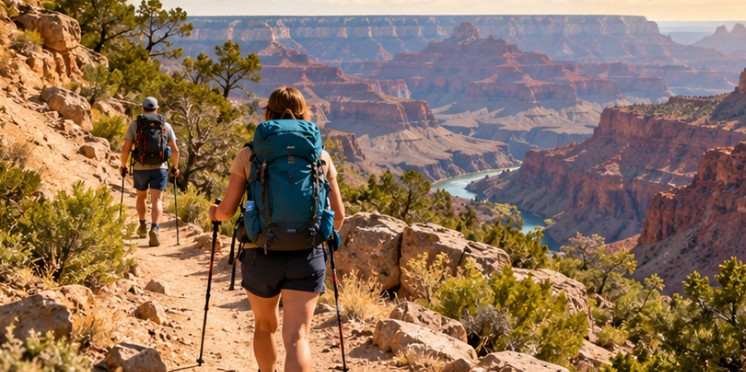
No. A solo traveler driving a large gasoline vehicle for thousands of miles can still create substantial emissions. The EPA notes that transportation emissions come from passenger vehicles, trucks, aircraft, ships, trains and other modes, with passenger cars and light- and heavy-duty road vehicles accounting for a major share of transportation emissions.
A smarter approach is to reduce unnecessary vehicle miles, favor shared transportation where practical and combine several experiences into one ground trip. A train-plus-bike itinerary, for example, can reduce the need for a rental car at the destination.
Environmental impact also depends on vehicle efficiency, occupancy, route length and the transport system being used. “No flight” should therefore be treated as a planning choice, not an automatic sustainability certificate.
FAQ
1. Can I visit U.S. national parks without flying?
Yes. Some parks connect with trains, regional buses, ferries or seasonal shuttles. Check the park’s official transportation page because final-mile service varies greatly.
2. Is train travel practical for outdoor adventures?
Often, especially when a station is close to a trail, gateway town or shuttle. The deciding factor is usually the connection after you leave the train.
3. Are no-fly trips always cheaper?
No. Rail sleepers, ferries and multiple ground connections can exceed discounted airfare. Compare the full trip, including baggage, rental cars, parking and lodging.
4. Can I combine cycling with train travel?
Yes, but bicycle policies differ by route and service. Confirm reservations, storage and station-handling rules before building the itinerary.
The Best No-Fly Trips Feel Bigger, Not Slower
The real appeal of adventure travel without flying is not simply avoiding an airport. It is recovering the distance between home and destination. A night train becomes part of the story. A ferry crossing reveals a coastline instead of skipping it. A bicycle route turns small towns into meaningful stops rather than places seen from cruising altitude.
Start with one reachable region, find a dependable transportation spine, verify the final mile and leave enough margin for the unexpected. The best no-flight adventure is not the one that travels farthest. It is the one where the journey itself earns a place in the itinerary.