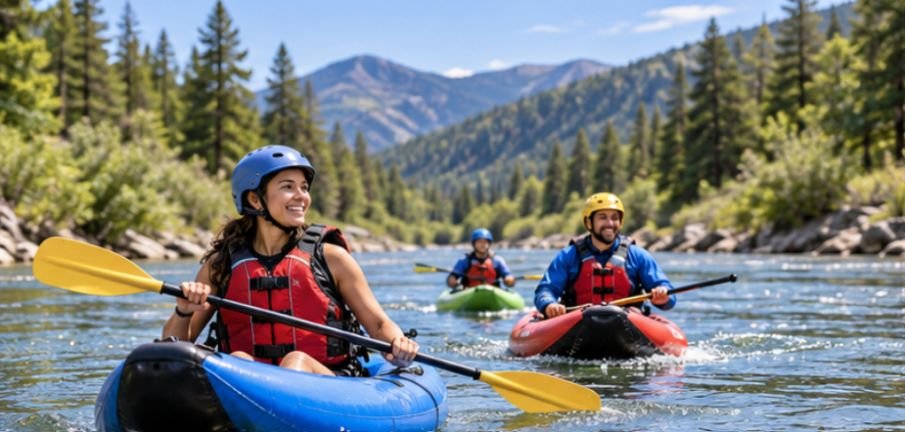
A Class II rapid on a normal summer day can be an ideal first taste of whitewater. That same stretch at unusually high flow may demand substantially more judgment and skill.
So, what class rapids are safe for beginners? For most first-time paddlers and rafters, Class I and Class II are the appropriate starting range. Class III can sometimes work for beginners on professionally guided rafting trips, but it should not automatically be treated as beginner water.
The number beside a rapid matters. Conditions, equipment, instruction, swimming ability, and the type of boat matter just as much.
The Short Answer: Start With Class I or Class II
The International Scale of River Difficulty runs from easy moving water through increasingly technical whitewater. American Whitewater describes Class I as beginner-level water and Class II as novice-level whitewater requiring some maneuvering. Class III moves into intermediate territory, with larger waves and features demanding more skilled boat handling.
The National Park Service river and stream safety guidance similarly describes Class I as moving water with small waves and few obstacles, while Class II normally has wide, clear channels and manageable waves.
For an absolute beginner, that creates a practical hierarchy:
| Rapid class | Typical beginner suitability | What to expect |
| Class I | Excellent | Moving water, riffles, small waves, few obstacles |
| Class II | Very good with proper equipment and instruction | Small rapids, clear routes, basic maneuvering |
| Class III | Conditional | Irregular waves, obstacles, stronger currents, more complex moves |
| Class IV+ | Not beginner terrain | Powerful whitewater requiring advanced skills and rescue preparation |
The classifications describe technical difficulty, not guaranteed safety.
Why Class I Is the Easiest Starting Point
Class I water gives newcomers room to learn what moving water actually feels like.
There may be riffles, mild current, and small waves, but routes are generally obvious and obstacles are limited. That makes Class I useful for practicing forward strokes, steering, entering current, stopping, and learning how a boat responds differently from one on a lake.
It is particularly river trips for families, cautious beginners, and paddlers who have little experience swimming in moving water.
But “Class I” does not mean risk-free. A fallen tree, cold water, an unexpectedly strong current, or a poorly fitted life jacket can still create serious problems.
That distinction matters because beginners often focus too heavily on wave size.
Class II Is Where Beginner Whitewater Really Starts
For many people, Class II provides the best combination of learning and excitement.
You begin encountering identifiable rapids rather than simple moving water. Small waves, rocks, eddies, and bends may require intentional steering, but the correct route is normally easy to recognize.
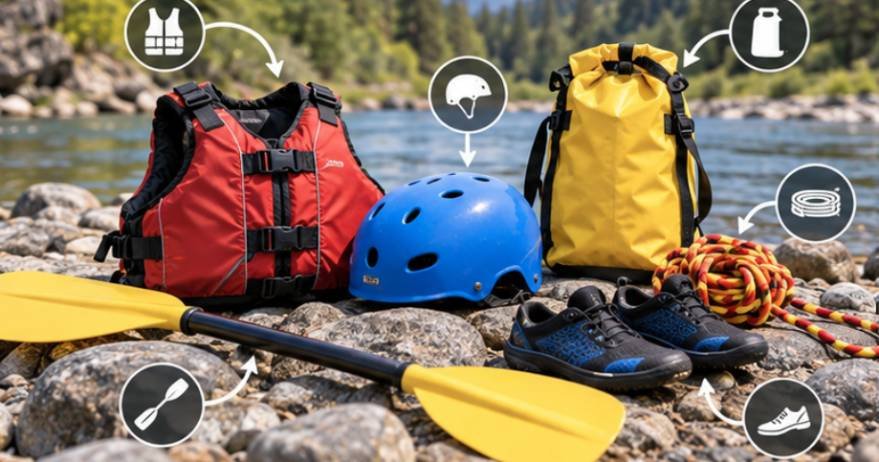
The American Canoe Association’s current equipment guidance recommends helmets for paddlers on Class II or harder water and requires properly fitted life jackets during paddling activities. Its safety curriculum also emphasizes rescue skills rather than relying solely on boat-handling ability.
See the American Canoe Association’s paddling equipment and safety guidance before choosing equipment for moving water.
Class II also appears frequently in structured beginner instruction. The University of Minnesota Duluth whitewater program, for example, uses Class I-II river running in courses intended for people who have never paddled a kayak before.
That is a better model than simply renting a boat and assuming an “easy” river will teach you everything.
Can Beginners Raft Class III Rapids?
Sometimes—but the word raft is important.
Class III water can contain higher, irregular waves, faster currents, narrower routes, and obstacles requiring deliberate maneuvering.
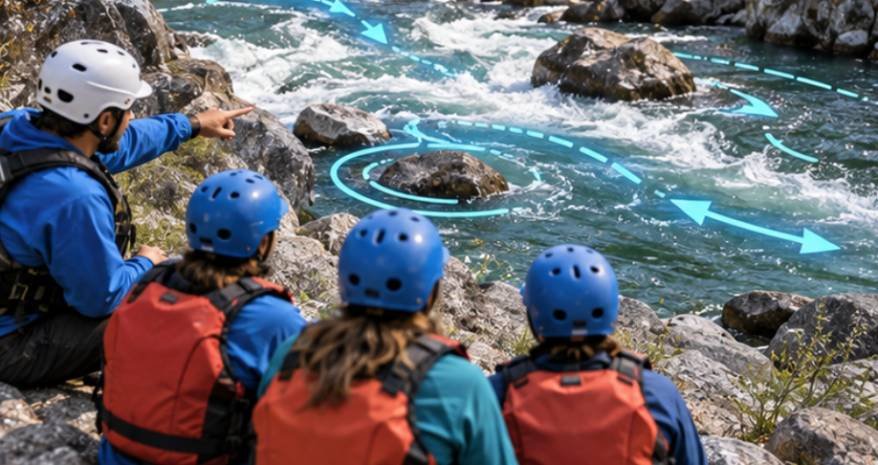
The National Park Service advises that scouting may be appropriate for inexperienced groups on Class III sections. For beginners comparing different ways to experience whitewater, beginner rafting vs kayaking can help explain how the responsibilities, skills, and learning curves differ between the two activities.”
The National Park Service advises that scouting may be appropriate for inexperienced groups on Class III sections.
A commercial raft with an experienced guide is very different from a beginner independently paddling a whitewater kayak.
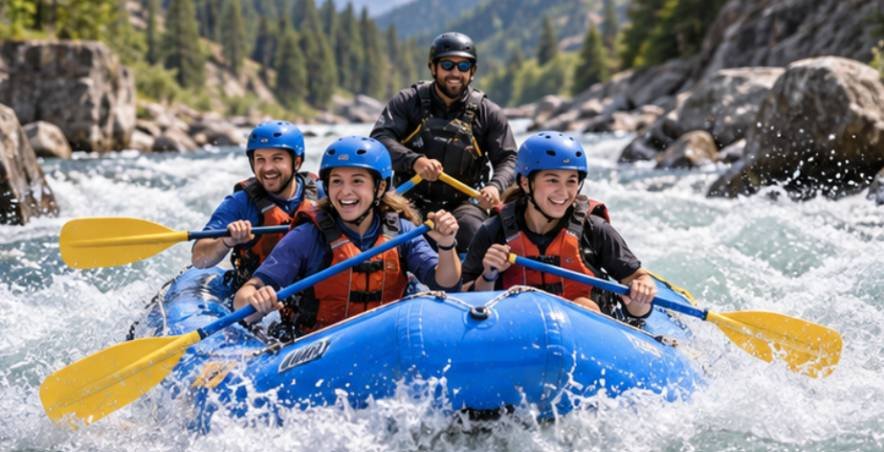
Guides can read the river, position the raft, issue paddle commands, anticipate hazards, and organize rescue if somebody falls overboard. That is why many U.S. outfitters take healthy first-time guests through selected Class III rapids.
Independent kayaking is another matter. Beginners must control their own boat, understand eddies and currents, recover from mistakes, and know what to do after a capsize.
Cornell University’s introductory whitewater kayaking program, for instance, begins with pool training and basic river skills before students progress toward Class II/III whitewater. You can review its beginner whitewater kayaking progression as an example of how formal instruction builds difficulty gradually.
Use the Five-Question Test Before Choosing a River
Instead of asking only what class rapids are safe for beginners, ask five questions before launching.
1. What is the highest rapid on the entire section?
A trip advertised as mostly Class II may contain one Class III rapid. Research the complete route rather than relying on the average difficulty.
2. What is today’s river level?
Rapid ratings can change with flow. Higher water can increase speed, wave size, hydraulics, and the consequences of missing a maneuver.
American Whitewater specifically warns that changing water levels can alter river difficulty.
Check local conditions and stream gauges. The U.S. Geological Survey streamgage network provides flow information from more than 13,500 gauges nationwide, including data used for recreational safety and water management.
3. What happens if I swim?
Imagine being outside the boat rather than safely sitting in it.
Are there rocks, strainers, cold water, strong currents, long rapids, or limited places to reach shore?
The National Weather Service warns that sudden cold-water immersion can quickly impair muscle control, even when the air feels warm.
4. Am I guided or responsible for my own boat?
A first-time commercial rafting passenger and a first-time solo kayaker should not use the same rapid-class threshold.
Beginners controlling their own craft should generally progress more conservatively.
5. Do I have appropriate equipment and rescue support?
Wear a correctly fitted paddling life jacket. On whitewater, helmets, appropriate clothing, suitable footwear, throw ropes, and properly designed boats may also be important.
A low rapid classification cannot compensate for poor preparation.
Why River Classifications Can Mislead Beginners
One widespread misconception is that every Class II river presents roughly the same challenge. It does not.
American Whitewater explicitly describes the International Scale as an approximate comparison system rather than a precise measurement. Regional interpretations differ, and river difficulty can change because of water levels, floods, fallen trees, geological changes, or weather.
A short Class II rapid with an easy recovery pool is different from continuous Class II water where swimmers have few opportunities to get ashore.
Similarly, low water is not automatically safer. Lower flows can expose rocks and create pinning or entrapment hazards that are less obvious at other levels. The lesson is simple: use rapid class as the beginning of your risk assessment, not the end.
Frequently Asked Questions
1. What is the safest rapid class for a first-time rafter?
Class I is the gentlest starting point. Class II is also commonly suitable for beginners, especially on professionally guided trips with proper equipment and normal river conditions.
2. Are Class III rapids safe for first-time rafters?
Some commercially guided Class III trips accept beginners. Suitability depends on water level, river characteristics, age or fitness requirements, weather, equipment, and the outfitter’s operating criteria.
3. Can beginners kayak Class II rapids?
Yes, but instruction is strongly recommended. Beginners should first learn basic strokes, boat control, wet exits, river reading, swimming procedures, and rescue fundamentals.
4. Does a higher river level make rapids harder?
Often, but not always in the same way. Higher flows may increase speed and wave size, while unusually low water can expose rocks and other hazards. Check current local river information.
Start Easy Enough to Learn, Not Merely Survive
The best first whitewater trip is not the biggest rapid you can somehow get through. It is a run that leaves enough margin to practice steering, read currents, recover from mistakes, and understand what the river is doing.
For most newcomers, Class I and Class II provide that margin. Selected Class III rafting trips may also suit adventurous beginners when reputable professional guides provide the equipment, commands, and safety systems.
Rapid classifications are useful shorthand, but rivers do not read their own ratings. Check the flow, weather, hazards, equipment, route, and people you are paddling with before deciding whether an “easy” rapid is truly easy today.