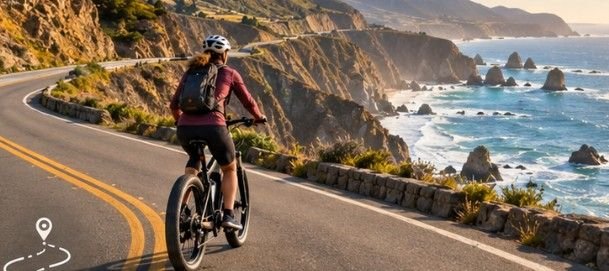
The biggest advantage of an e-bike is not speed. It is the ability to turn hills, headwinds, longer mileage, and mixed fitness levels from trip-ending problems into manageable parts of the ride.
That makes the best e bike adventure destinations places where electric assistance unlocks more scenery without sacrificing the experience of actually traveling through the landscape. But access matters as much as beauty: a spectacular trail is useless if your particular class of e-bike is prohibited there.
The U.S. now offers everything from car-free carriage roads in Maine to desert singletrack in Utah and dramatic coastal highways in California. The catch is that e-bike rules still change by state, park, trail system, and bike class.
What Makes an E-Bike Destination Actually Worth the Trip?
A good electric-bike vacation needs more than an attractive route. I would judge a destination on five factors: legal access for the bike class you own, route surface, climbing difficulty, traffic exposure, and realistic battery logistics.
That first factor deserves special attention. Class 1 bikes generally provide pedal assistance up to 20 mph. Class 2 models can use a throttle up to 20 mph, while Class 3 pedal-assist models can assist up to 28 mph. Local rules do not necessarily give all three classes equal access.
PeopleForBikes maintains state-by-state information because regulations vary significantly across the country. Checking the law before booking lodging is far easier than discovering at the trailhead that your bike is excluded.
Five E Bike Adventure Destinations With Very Different Personalities
| Destination | Ideal riding style | Major advantage | Important limitation |
| Acadia, Maine | Gravel sightseeing | 45 miles of historic carriage roads | Carriage roads permit Class 1 only |
| Jackson/Grand Teton, Wyoming | Scenic paved riding | Mountain views with pathway access | Backcountry trails are off-limits |
| Moab, Utah | Electric mountain biking | Extensive Class 1 trail access | Technical terrain still demands skill |
| California Pacific Coast | Road touring | Ocean scenery and assisted climbing | Traffic, wind and narrow shoulders |
| California State Parks | Mixed recreational riding | Many designated Class 1 opportunities | Rules vary park by park |
Acadia National Park, Maine: The Low-Stress Scenic Choice
Acadia is unusually well suited to riders who want genuine adventure without spending the day mixing with highway traffic.
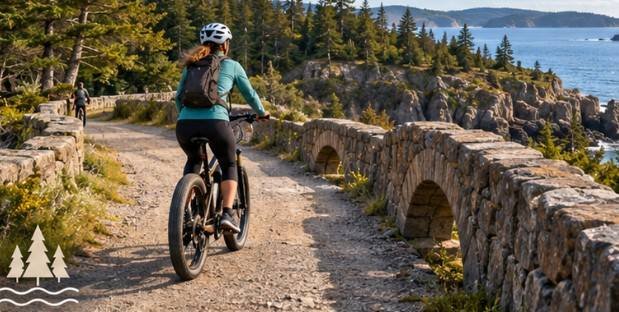
The park contains 45 miles of historic carriage roads winding through forests, around lakes, over stone bridges, and across Mount Desert Island. As per the National Park Service Acadia bicycling guidance it permits Class 1 e-bikes on the carriage roads, while Class 2 and Class 3 models are prohibited there. A 20 mph limit applies, and cyclists must yield to other users.
That combination makes Acadia particularly appealing to couples or groups whose riders have different fitness levels. The electric assist smooths out the elevation changes, while the crushed-rock roads provide a slower, more immersive alternative to road touring.
Spring mud closures can affect the carriage roads, and Park Loop Road presents an entirely different challenge because portions have traffic and no shoulder. Check the official rules before setting out.
Jackson and Grand Teton, Wyoming: Mountain Scenery Without Technical Singletrack
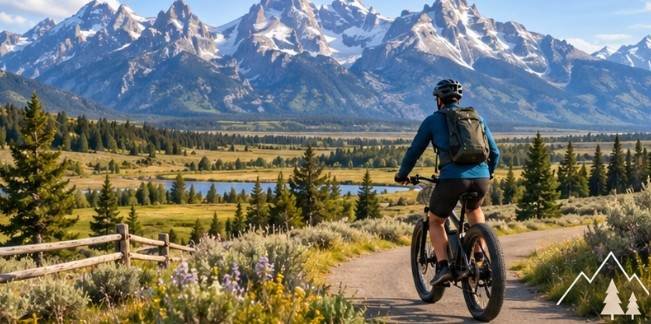
Jackson offers a different kind of electric-bike trip: broad western landscapes viewed from a paved pathway rather than rugged mountain-bike trails.
The Grand Teton Pathway runs north from Jackson into the park, continuing toward Moose and Jenny Lake. E-bikes meeting the park definition—operable pedals and a motor under 750 watts—can use appropriate paved and unpaved roads and the pathway. Bicycles are not permitted on park trails or in backcountry areas.
Wildlife adds another planning dimension. The NPS advises keeping at least 25 yards from animals such as moose, elk, and bison and 100 yards from bears and wolves. That matters on an e-bike because higher assisted cruising speeds can shorten reaction time.
This is a strong option for riders who value scenery and distance more than technical terrain.
Moab, Utah: A Major Upgrade for Class 1 E-MTB Riders
Moab has become considerably more relevant to electric mountain bikers.
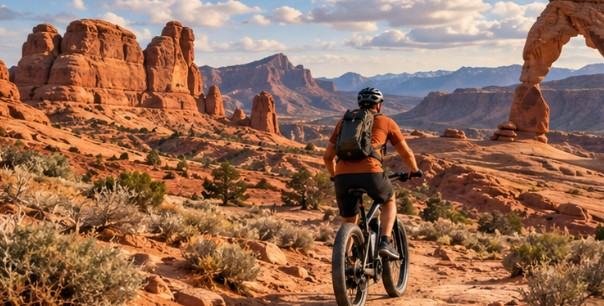
Beginning March 1, 2026, the Bureau of Land Management opened nearly 200 miles of selected mountain-bike trails around its Moab Field Office to Class 1 e-bikes. It’s current Moab e-bike trail information with approved areas include trail systems such as Navajo Rocks, Gemini Bridges, Klondike Bluffs, Moab Brands, and Amasa Back. Several trails remain closed to e-bikes, so “Moab allows e-bikes” is far too broad a statement.
Motor assistance also does not turn technical desert riding into beginner terrain. Rock ledges, loose surfaces, exposure, heat, braking technique, and bike handling still matter. Assistance helps with effort; it does not replace skill.
California’s Pacific Coast: Spectacular but Not Beginner-Friendly
California’s coastline is perhaps one of the most best place to travel for adventure and relaxation. Most cinematic option on this list. Electric assistance is particularly valuable on repeated coastal climbs, but riders should not confuse easier climbing with easier riding.
Adventure Cycling describes the Pacific Coast route as a mixture of highways, urban roads, bike paths, steep headlands, and sections with heavy vehicle traffic. Along parts of Highway 1, shoulders can be narrow or absent. The organization specifically recommends defensive riding and identifies spring and fall as preferable periods for many California sections.
A capable e-bike can flatten the physical difficulty of Big Sur’s climbing, but it cannot widen a shoulder or reduce traffic. Experienced road riders will appreciate this destination far more than first-time cyclists.
California State Parks: Build Your Own E-Bike Vacation
For travelers who prefer shorter rides rather than a multi-day highway tour, California’s state-park system creates another option.
Designated Class 1 access exists at locations ranging from Folsom Lake State Recreation Area to Crystal Cove and other individual units. However, e-bike access is established park by park and sometimes trail by trail. Public roads and recreational trails can also operate under different rules.
That makes California ideal for building a trip around several shorter rides—but poor territory for assuming that a bicycle symbol automatically means your e-bike is permitted.
The Simple Range Test I Would Use Before Any Adventure
Do not build a route around the maximum mileage printed in an e-bike advertisement. Elevation, rider weight, cargo, tire pressure, temperature, wind, surface, and assistance level all affect real-world consumption.
For 3 day adventure trips on an unsupported ride, I would keep a substantial reserve. If the bike is marketed for 60 miles under favorable conditions, for example, I would not automatically plan a remote 60-mile ride. A route closer to 35–40 miles leaves room for climbs, detours, headwinds, and higher-than-expected assist use.
Also check tire pressure, brakes, chain, battery attachment, lights, tools, water, navigation, and the return distance before leaving. The heavier weight of many e-bikes means braking and handling deserve extra attention.
What About International E-Bike Adventures?
American riders looking overseas have dramatically different options. Tuscany pairs rolling roads and historic towns with assisted climbing. The Netherlands emphasizes dense cycling infrastructure and relatively flat riding. Ecuador’s Avenue of the Volcanoes moves in the opposite direction, combining high-altitude terrain with major mountain scenery.
Those trips can be exceptional, but airline battery restrictions, rentals, local road rules, tour support, and charging logistics make renting an e-bike locally much more practical than simply treating an international trip like a domestic road journey.
Frequently Asked Questions
1. What is the best U.S. destination for a beginner e-bike trip?
Acadia is particularly approachable because its carriage-road network separates much of the ride from vehicle traffic. Only permitted e-bike classes should be used.
2. Can e-bikes go anywhere regular mountain bikes can?
No. Land managers may permit traditional bicycles while restricting some or all e-bike classes. Always check the specific trail manager’s current rules.
3. Is an e-bike suitable for the Pacific Coast Highway?
Yes for experienced road riders, but electric assistance does not eliminate traffic, narrow shoulders, wind, fog, or demanding descents.
4. How much battery range should I leave in reserve?
Avoid planning around the advertised maximum. Leaving roughly one-third of expected capacity as a practical buffer can protect against climbing, wind, detours, and heavier assist use.
The Ride Matters More Than the Motor
The most rewarding e bike adventure destinations are not simply places with steep hills that electricity makes easier. They are places where the motor quietly removes a barrier and lets the landscape become the main event.
Acadia offers historic, mostly traffic-free exploration. Jackson puts the Tetons in front of your handlebars. Moab adds legitimate Class 1 desert riding, while California rewards stronger road riders with extraordinary coastline. Choose the route only after checking your bike class, access rules, terrain, battery margin, and traffic exposure. The smartest e-bike adventure starts before you press the power button.