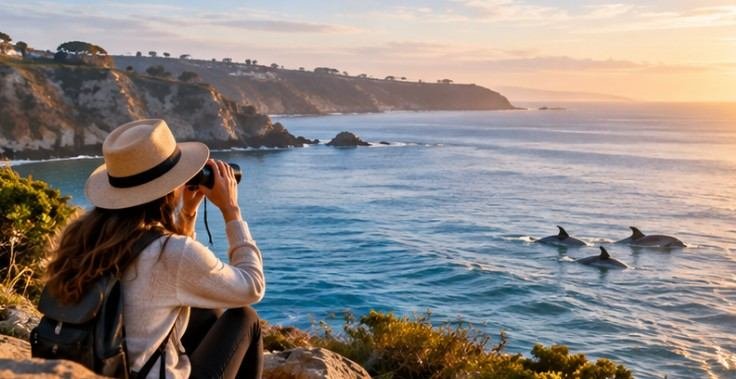
A dolphin sighting does not require a boat ticket. Along several U.S. coastlines, bottlenose and common dolphins pass close enough to beaches, bluffs, and piers to be seen with the naked eye. The best places to see dolphins from shore combine open views over productive water with enough elevation or shoreline length to follow moving animals.
Calm seas, feeding birds, baitfish activity, and a wide field of view often matter more than a famous beach name.
Where Shore-Based Dolphin Watching Works Best
| Location | Why it works | Useful timing |
| Buxton/Cape Hatteras, North Carolina | Long Atlantic beaches near productive currents | Calm mornings |
| Point Dume, Malibu, California | High bluffs over Santa Monica Bay | Clear, low-wind periods |
| West Cliff Drive, Santa Cruz, California | Elevated path above Monterey Bay | Year-round; late summer is notable |
| Heisler Park, Laguna Beach, California | Bluff overlooks above coves | Calm mornings |
| Myrtle Beach State Park, South Carolina | Unobstructed Atlantic shoreline | Early morning |
| Gulf Islands National Seashore, Florida/Mississippi | Barrier-island beaches with regular dolphin activity | Calm, clear days |
Buxton and Cape Hatteras, North Carolina
Cape Hatteras is a strong East Coast choice because the Outer Banks extend far into the Atlantic. The National Park Service says the area supports a resident bottlenose dolphin population and that marine mammals may feed close to Cape Hatteras beaches, influenced by the Gulf Stream and Labrador Current.
Around Buxton, scan parallel to shore as well as offshore because traveling dolphins may surface repeatedly along the same route. Check the official Cape Hatteras National Seashore wildlife guidance before visiting.
Point Dume, Malibu, California
Point Dume gives watchers an advantage flat beaches cannot: height. California State Parks says the promontory offers opportunities to see dolphins in the surf, sometimes only a few dozen feet offshore.
The bluff overlooks let you sweep a large section of Santa Monica Bay. Check California State Parks’ Point Dume page for current access information.
West Cliff Drive, Santa Cruz, California
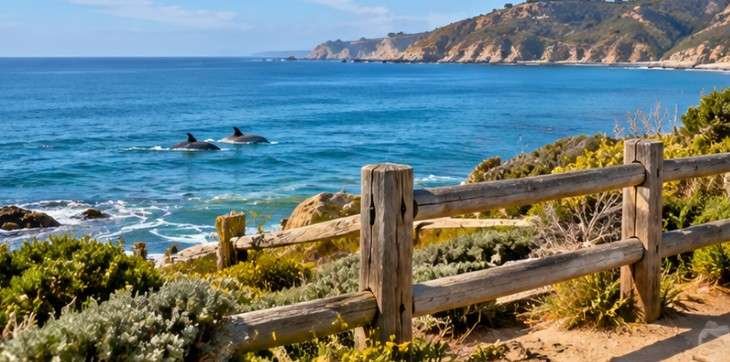
West Cliff Drive follows roughly three miles of Monterey Bay shoreline and offers repeated elevated viewpoints. Local tourism information notes that whales and dolphins may be seen swimming parallel to shore there.
Monterey Bay National Marine Sanctuary reports that long-beaked common, Risso’s, and Pacific white-sided dolphins occur year-round, with several species more abundant in August and September. Late summer can therefore be productive, though no sighting is guaranteed.
Heisler Park, Laguna Beach, California
Laguna Beach combines bluff-top paths, coves, and clear nearshore water. Heisler Park sits above the Pacific and is part of a protected coastal area studied by the Multi-Agency Rocky Intertidal Network at UC Santa Cruz.
Local tourism guidance says common dolphins are occasionally spotted from shore. Start from the bluff; even modest elevation makes dorsal fins easier to separate from breaking waves.
Myrtle Beach State Park, South Carolina
The Grand Strand provides long sight lines across nearshore Atlantic water. Local reporting identifies Myrtle Beach State Park as a useful shore-watching location, particularly early in the morning.
South Carolina’s Department of Natural Resources says bottlenose dolphins are common in state estuaries and open water and can be observed from shore. See the South Carolina DNR bottlenose dolphin profile for regional behavior and conservation information.
Gulf Islands National Seashore, Florida and Mississippi
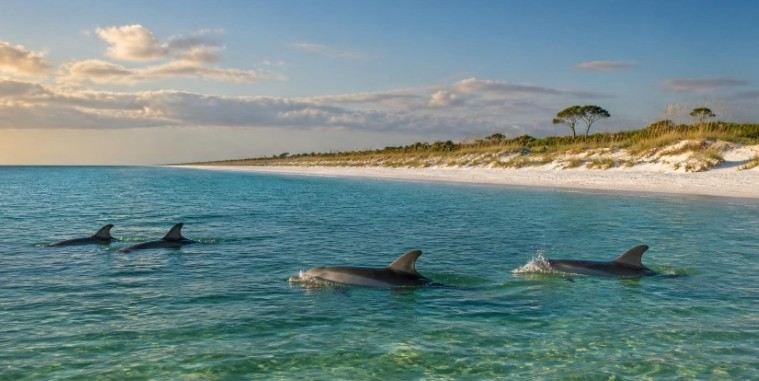
The National Park Service explicitly says visitors can spot bottlenose dolphins from Gulf Islands National Seashore beaches across Florida and Mississippi. The park also reports several dolphin species in its waters.
For wider habitat context, the Florida Museum’s aquatic ecosystem resource explains why bottlenose dolphins commonly use productive coastal and estuarine waters.
A Five-Minute Dolphin Scan
Most missed sightings happen because people stare at one patch of ocean. A simple scan works better:
- Begin from the highest safe viewpoint and watch just beyond the breakers for one minute.
- Shift farther offshore and look for curved fins, repeated splashes, baitfish, or several birds diving together.
- If one fin appears, follow its direction for 20 to 30 seconds; another surfacing may occur ahead.
- Use binoculars after detecting movement with your eyes. A narrow binocular view makes initial searching harder.
- If glare is strong, move along the shore until the sun angle changes.
Early morning often helps because water can be calmer and glare lower. Get to know of island hopping routes and ferry schedules well in advance. As high tide is not a universal dolphin rule. Tides can affect prey locally, but sea state, food distribution, season, and geography are usually better clues.
Watch Without Changing Their Behavior
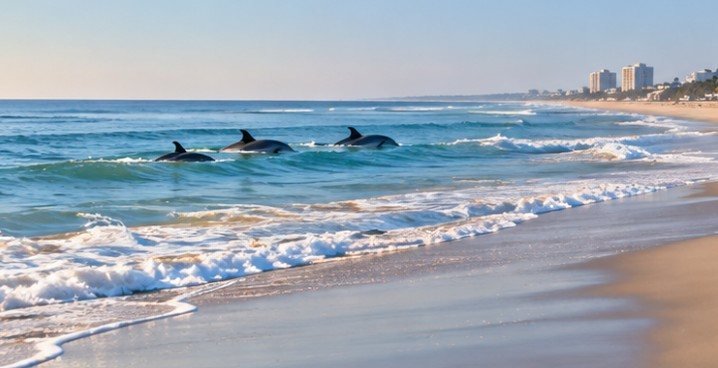
NOAA recommends staying at least 50 yards from wild dolphins and says feeding or harassing them is illegal. It also recommends binoculars or telephoto lenses instead of approaching wildlife.
Review NOAA Fisheries’ marine-life viewing guidelines before a trip. From beach, pier, paddleboard, or boat, the goal is to watch without making animals change course, stop feeding, or approach people.
What Shore Watchers Often Get Wrong
Do not expect constant jumping. Many sightings are quiet: a dorsal fin surfaces, disappears, then appears farther along the coast. Midday glare and choppy water can hide this.
Wave tips, sea lions, and diving birds are also easy to mistake for dolphins. A dolphin usually shows a smooth back and curved dorsal fin in a repeatable travel pattern.
Frequently Asked Questions
1. What is the best time of day to see dolphins from shore?
Early morning often offers calmer water and less glare. Dolphin activity varies with prey, weather, season, and location, so morning improves visibility rather than guaranteeing a sighting.
2. Can I see dolphins from shore without binoculars?
Yes. Dolphins near the surf can be visible with the naked eye, especially from cliffs or piers. Binoculars are most useful for confirming distant animals.
3. Are dolphins more common at high tide?
Not everywhere. Tides may influence feeding locally, but there is no nationwide rule. Sea conditions, prey location, season, and coastal geography may matter more.
4. What should I do if a dolphin comes very close to shore?
Do not enter the water, feed it, or touch it. Keep your distance. If the animal appears stranded or distressed, contact the local marine mammal stranding network.
Patience Is the Real Advantage
The most memorable dolphin encounter may last only seconds: one clean dorsal fin, then another, moving quietly past the beach. That is why the best places to see dolphins from shore are less about guaranteed “shows” than about putting yourself where marine life is visible without disturbing it. It could be a part of your weekend adventure getaways for couples.
Choose a high, open viewpoint, arrive when the water is easy to read, scan methodically, and give wildlife space. Even on a dolphin-free day, those habits make you a better observer, improve your chances on the next visit, and leave the animals free to behave naturally.