Standing on the sun-baked asphalt of Piraeus Port at 6:45 AM, surrounded by thousands of travelers and exhaust fumes from roaring marine diesels, you realize that sea transit in Greece operates under its own physics. If you miscalculate your connections, your dream vacation turns into a frustrating marathon of missed connections and stranded luggage. This island hopping routes and ferry schedules guide breaks down exactly how to navigate island corridors, decode ferry operator timetables, and prevent costly transit mistakes before you step aboard.
[ Athens (Piraeus / Rafina) ]
│
┌───────────┴───────────┐
▼ ▼
[ Classic Cyclades ] [ Western Cyclades ]
- Mykonos • Serifos
- Paros • Sifnos
- Naxos • Milos
- Santorini
The Cardinal Rule: Stick to Linear Corridors
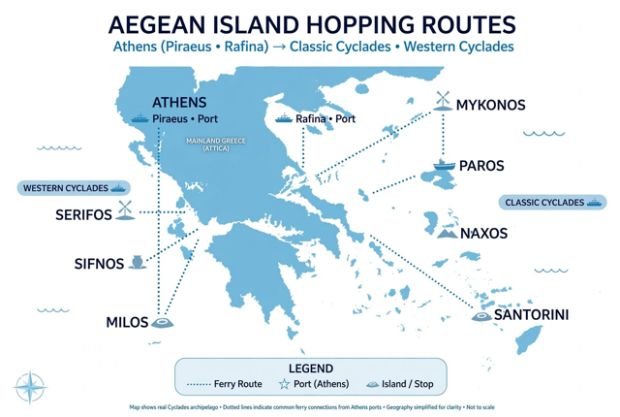
The most common mistake I see travelers make is treating the Greek archipelago like a metro map where every line connects. Island groups function as distinct, self-contained sea corridors. If you try to jump directly from Mykonos (Cyclades) to Corfu (Ionians), you face an all-day ordeal: an early-morning ferry back to mainland Athens, a cross-country bus or flight, and a second ferry across the western sea.
To prevent wasted transit days, choose a single chain and spend at least 2 to 3 nights per stop. Pick a hub island where you can base yourself for regional exploration, using localized commuter water taxis for day trips rather than repacking every morning.
Classic Cyclades: Athens to Santorini
This corridor is the standard introduction to Greek ferry travel:
$$\text{Athens (Piraeus or Rafina)} \longrightarrow \text{Mykonos} \longrightarrow \text{Paros} \longrightarrow \text{Naxos} \longrightarrow \text{Santorini}$$
High-speed catamarans run the Athens–Mykonos leg in roughly 2.5 to 3 hours, while conventional ferries take 4.5 to 5.5 hours. Short island-to-island connections (like Paros to Naxos) take just 30 to 45 minutes, making this chain easy to navigate for first-timers.
Western Cyclades: Quiet Volcanic Escapes
For fewer crowds, cleaner ports, and dramatic volcanic coastlines, follow this route:
$$\text{Athens (Piraeus)} \longrightarrow \text{Serifos} \longrightarrow \text{Sifnos} \longrightarrow \text{Milos}$$
Catamarans reach Milos in about 3 hours and 15 minutes, whereas conventional ships take 5.5 hours. This corridor features far less port congestion than Santorini or Mykonos.
Dodecanese Chain: Medieval Outposts Near the Turkish Coast
Running southeast toward Turkey, this line showcases Rhodes, Symi, Kos, and Leros. The Rhodes-to-Symi leg is a scenic 50-minute dash. Because this chain sits far from Athens, take an overnight ferry with a sleeper cabin or book a quick domestic flight to Rhodes before hopping northward by sea.
Cracking Ferry Schedules and Seasonal Timetables
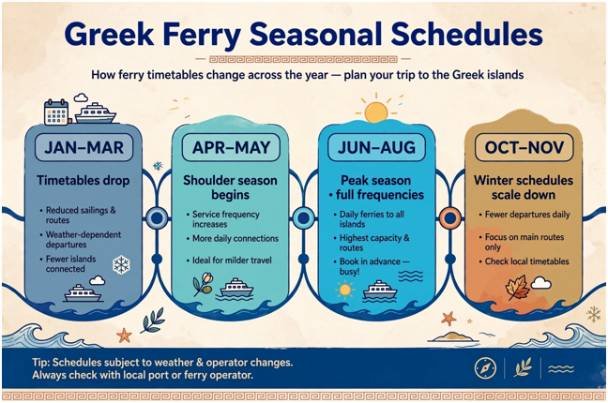
Greek ferry schedules are heavily seasonal. Planning an itinerary requires knowing when timetables become available and how weather impacts departures.
JAN – MAR APR – MAY JUN – AUG OCT – NOV
Timetables drop Shoulder season begins Peak season Winter schedules
Routes open online High-speed services launch Full daily frequencies Services scale down
The Winter Release Window
Ferry operators publish their summer timetables between January and March each year. If you search for July routes in November, search aggregators like Ferryhopper will show zero availability. That does not mean ferries will not run; the Ministry of Maritime Affairs simply has not yet approved the seasonal licenses. To map out routes in advance, use Greek Travel Pages (GTP Ferry Connections) to review historical schedules from past seasons.
The Meltemi Wind Factor and Buffer Days
From late June through August, strong northern winds called the Meltemi sweep across the Aegean. While large conventional ferries handle Force 7 to 8 gales with ease, lightweight catamarans are frequently held in port by the Hellenic Coast Guard for passenger safety.
Never book a return ferry to Athens on the same day as an international flight home. Always keep a 24-hour buffer day in the capital at the end of your trip. A single delayed catamaran can easily cause a missed transatlantic connection.
Choosing Your Vessel: High-Speed Catamarans vs. Conventional Ships
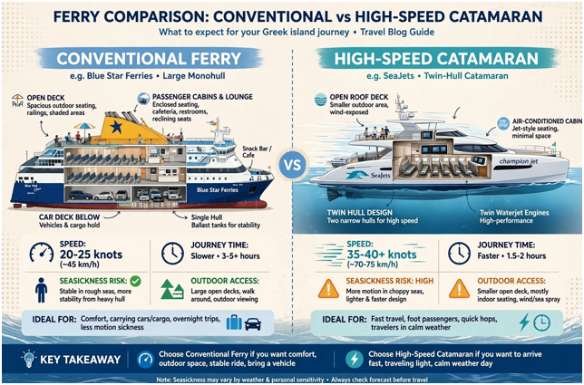
Ferry selection comes down to a balance between travel time, comfort, and sea conditions.
| Feature | Conventional Ferry (e.g., Blue Star Ferries) | High-Speed Catamaran (e.g., SeaJets) |
| Speed | 20–25 knots (Relaxed pace) | 34–40 knots (Halves travel times) |
| Outdoor Access | Full open decks with seating | Enclosed, no deck access underway |
| Seasickness Risk | Low (Heavy displacement hull) | High in rough Meltemi swells |
| Vehicle Capacity | 200–800 cars and trucks | Limited or foot passengers only |
| Price Point | Budget-friendly | Premium (Roughly 1.8x to 2x standard fares) |
For open-air views and steady sailing, large conventional vessels offer a far more pleasant cruise. Reserve high-speed catamarans for short, 30-to-60-minute hops where saving time outweighs the bumpier ride.
Ticket Classes, Cabins, and Real Transit Costs
Fares remain fixed throughout the season on standard routes, but ticket tiers determine your onboard comfort:
- Deck / Economy (€20–€55): Grants access to open outdoor seating and indoor cafeterias. Arrive early to secure a comfortable corner booth.
- Air Seats (€35–€65): Assigned, reclining airplane-style seats inside dedicated, quiet, air-conditioned lounges.
- High-Speed Assigned Seating (€60–€95): The standard ticket class for catamarans.
- Private Sleeper Cabins (€90–€220): Essential for long overnight crossings to Rhodes or Crete. A two-berth exterior cabin provides a private bathroom and shower while saving you the cost of a hotel night.
If you are traveling on a tight budget across multiple islands, carefully track smaller expenses like terminal snacks and port transfers. Take time before your departure to learn how to manage money and exchange currency while traveling so bank fees and unfavorable card exchange rates do not quietly erode your trip funds.
Boarding Chaos: Luggage Racks, Car Decks, and Ramp Etiquette
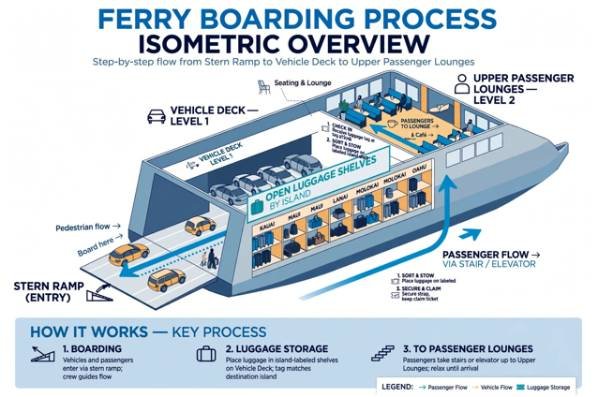
Boarding a Mediterranean ferry resembles an organized emergency drill. The massive stern ramp drops, vehicle engines rev, crew members shout instructions over engine noise, and crowds surge forward.
[ PASSENGER ENTRY ]
│
▼
[ Stern Ramp ] ──► [ Vehicle Deck: Open Luggage Shelves ] ──► [ Upper Passenger Lounges ]
(Drop bags by island name) (Carry daypack & valuables)
Keep these procedures in mind:
- Luggage Storage: Inside the car deck, you will see massive steel shelving units marked with island names. Drop your large suitcase on the rack labeled for your destination.
- Keep Valuables Close: Vehicle decks are locked once the ship gets underway. Bring a separate daypack containing your passport, phone chargers, medications, and valuables to the upper passenger lounge.
- The 7-Minute Disembarkation Rush: At intermediate islands, ferries dock for only 7 to 10 minutes. When shipboard loudspeakers announce your port, head down to the vehicle deck immediately, grab your bag from the rack, and wait at the ramp door.
Master the Ports: Piraeus, Rafina, and Lavrio
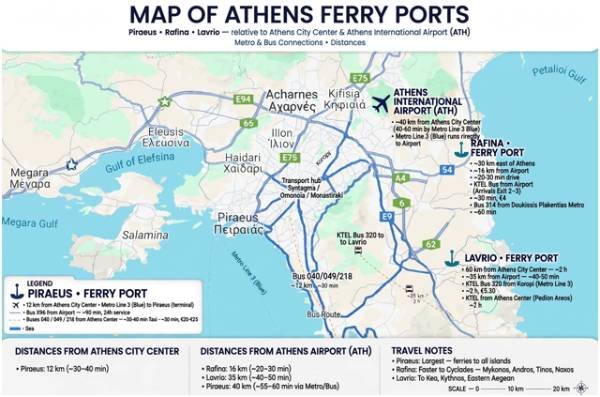
Athens is served by three distinct ferry departure ports:
- Piraeus: The main hub, directly connected to Athens city center via Metro lines 1 (Green) and 3 (Blue). Gate E6/E7 serves Central Cyclades foot passengers, while Gates E1 and E2 handle long-distance ships to Crete and the Dodecanese. The port spans several miles, so arrive at least 60 minutes prior to departure.
- Rafina: Located on the eastern coast of Attica, Rafina sits much closer to Athens International Airport (ATH) than Piraeus. A 30-minute regional bus or taxi ride takes you straight to the docks. It serves as the top launchpad for Andros, Tinos, and Northern Mykonos.
- Lavrio: The southernmost port, primarily serving Kea, Kythnos, and remote eastern Aegean lines.
Smooth Sailing Ahead
Island hopping through the Mediterranean is an unforgettable travel experience, provided you work with maritime logistics rather than against them. Map your route along linear corridors, book your cabin early via Direct Ferries or direct carrier sites, and protect your return flight with a solid buffer day.
Step out onto the open deck as the engines rumble to life, grab an iced espresso from the cafeteria, and watch the whitewashed cliffside towns rise from the blue waters of the Aegean.
Frequently Asked Questions
1. What is the best app for tracking Greek ferry schedules?
Ferryhopper is widely considered the best tool for checking multi-leg routes, live vessel locations, and booking mobile e-tickets.
2. Are luggage bags weighed or limited on passenger ferries?
Greek ferry operators allow up to 50 kg of luggage per person, and bags are almost never weighed or measured at boarding ramps.
3. Can I book ferry tickets directly at the port?
You can buy tickets at port kiosk ticket booths on the day of travel, but high-season routes and vehicle spaces regularly sell out weeks in advance.
4. Why are high-speed catamarans delayed more often than conventional ferries?
Catamarans have lightweight, shallow-draft hulls that cannot safely navigate heavy Meltemi swells, leading to weather delays enforced by port authorities.