
After fifteen years of mapping routes across five continents, I learned the hard way that ambition kills good vacations. My early spreadsheets were masterpieces of cartography, but real-world execution left me stranded on delayed platforms and checking into hotels at midnight. Mastering step by step travel itinerary planning for multi stop trips comes down to controlling friction, not packing every hour with landmarks.
A seamless route requires a clear mathematical structure before you ever look at hotels. Here is how I organize complex multi-city journeys to preserve both my budget and my sanity.
1. Establish Route Geometry: Open-Jaw vs. Train Loops
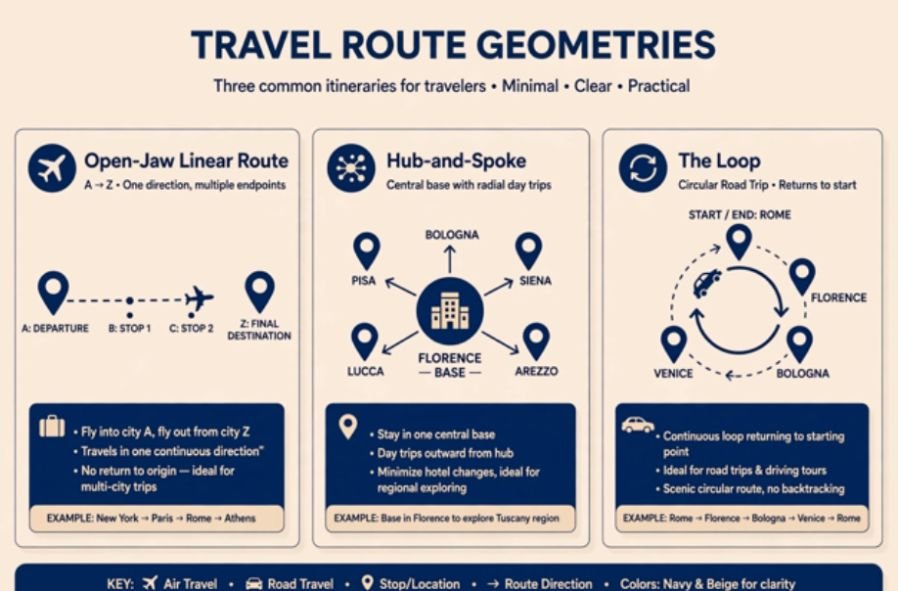
The geometry of your route dictates your total transit fatigue. Most travelers reflexively book a standard round-trip ticket into and out of the same city because the sticker price seems cheaper. This choice often forces an unnecessary, expensive loop back to the starting point.
When designing a route, compare the total price of an open-jaw ticket (flying into City A and out of City Z) against an internal loop:
Choosing the best remote travel destinations without crowds can also make a multi-stop route more manageable and enjoyable.
| Route Type | Best Used For | Primary Benefit | Hidden Drawback |
| Open-Jaw (Multi-City) | Linear journeys (e.g., Tokyo to Hiroshima) | Zero backtracking; saves a full travel day | Higher baseline airfare on select routes |
| Hub-and-Spoke | Regional exploration (e.g., base in Florence) | Unpack once; simple logistics | Daily local train fares accumulate quickly |
| The Loop | Circular road trips with a rental car | Avoids one-way vehicle drop fees | Rigid schedule; locks you to a single endpoint |
I regularly use Google Flights to price multi-city legs against standard round-trips. If you plan to [plan a 3 week cross country train trip], mapping out your track geometry early keeps your transit seamless.
The 4-Hour Transit Threshold
I follow a strict operational rule: if the train ride from your final destination back to your origin airport takes more than four hours, book an open-jaw flight.
According to regional transit data compiled by rail operators and analyzed via Seat61, once internal train travel crosses the 4-hour mark, door-to-door transit eats an entire working day. Factor in the cost of an extra hotel night at your origin city, and that “cheap” round-trip ticket ends up costing more than the multi-city fare.
2. Calculate the Net Usable Hours (NUH) Formula
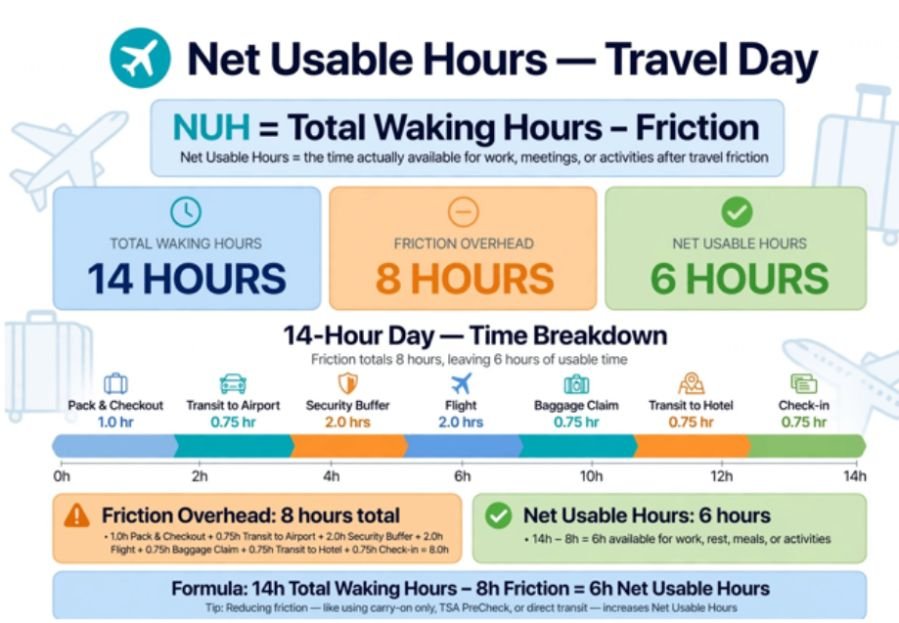
A two-hour flight is never just two hours. The biggest planning mistake is treating travel days as vacation days. In reality, switching hotels drains physical energy and consumes between five and seven hours of unstructured time.
To set realistic schedules, I calculate Net Usable Hours (NUH) for every transition day:
$$\text{NUH} = \text{Total Waking Hours} – (\text{Hotel Checkout} + \text{Transit Buffers} + \text{Station/Airport Processing} + \text{Door-to-Door Travel} + \text{Check-in})$$
Typical Flight Transition Day (2-Hour Flight):
– Pack & Checkout: 1.0 hr
– Transit to Airport: 0.75 hr
– Security Buffer: 2.0 hrs
– Flight Duration: 2.0 hrs
– Baggage Claim & Exit: 0.75 hr
– Transit to Hotel: 0.75 hr
– Check-in & Settle: 0.75 hr
Total Friction Overhead = 8.0 Hours
Review data from the Bureau of Transportation Statistics on departure delays, and you will see why buffer padding is essential. If you have eight hours of friction in a 14-hour day, you only have six net usable hours left. Never schedule major museum visits or high-stakes dinners on arrival days.
3. Cluster Sights by Geography and Pacing
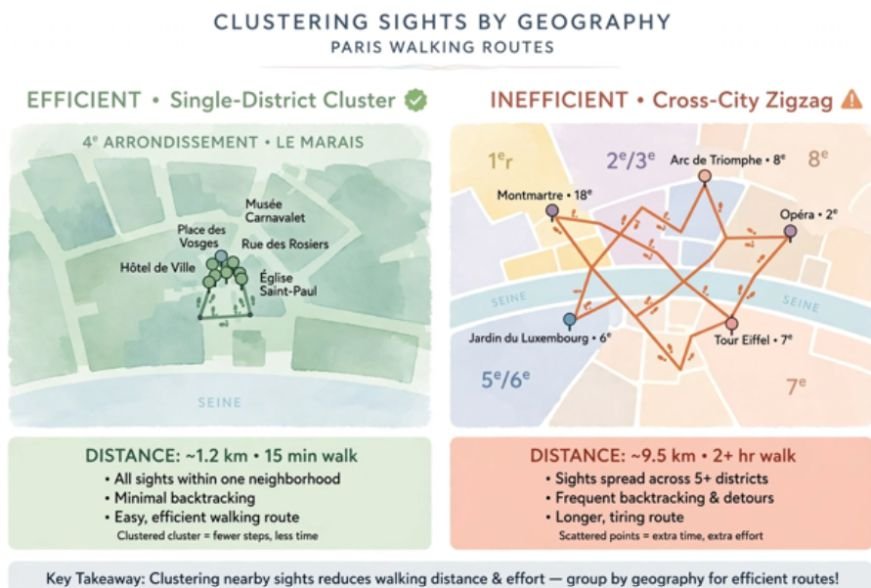
Once your primary stops are set, group your daily activities strictly by physical neighborhood. Jumping across a city like Paris or New York three times a day wastes hours in transit.
I enforce a strict Two-Night Minimum per base. Single-night stays create constant packing friction and leave you with zero uninterrupted days to explore.
| Stay Duration | Full Exploration Days | Suitcase Moves | Pace Rating |
| 1 Night | 0 full days (arrival/departure only) | Daily | Exhausting |
| 2 Nights | 1 full, uninterrupted day | Every 48 hours | Manageable sprint |
| 3+ Nights | 2+ full days | Low frequency | Sustainable slow travel |
Carrying minimal luggage makes these transitions painless. Review this essential packing checklist for long term slow travel to streamline your packing and eliminate luggage baggage fees.
4. Lock Long-Haul Bookends Before Mid-Tier Transfers
Lock in your international flights first. These “bookend” dates establish the non-negotiable boundaries of your trip.
Once your entry and exit points are secured, book your internal high-speed rail lines or regional flights. Leave regional bus connections, ferries, and intra-city metro cards for arrival week. Booking from the outside in ensures you never hold an unchangeable regional train ticket for a day you cannot reach.
5. The Two-Anchor Daily Rule for Energy Management

Rigid itineraries produce stressed travelers. I structure every day around just two locked anchors:
- Morning Anchor: One timed event (e.g., a timed gallery entry reserved weeks ahead).
- Evening Anchor: One fixed reservation (e.g., a curated dinner or theater performance).
Keep the entire midday period open. If you spend your morning hiking in a national park that requires strict access via the National Park Service reservation system, leave the afternoon open for a slow lunch or spontaneous detours.
Frequently Asked Questions
1. How many cities should I visit in a two-week trip?
Limit a two-week trip to a maximum of three bases to avoid spending half your vacation in transit.
2. Is an open-jaw flight always more expensive than a round-trip ticket?
No, when you factor in the saved return train fare and extra hotel night, open-jaw flights are often cheaper overall.
3. What is the best way to keep track of multiple travel confirmations?
Store PDF tickets in an offline folder on your phone and organize confirmation numbers chronologically in a single digital notes file.
4. How much buffer time should I leave between train transfers?
Leave at least 30 to 45 minutes for international train connections to absorb minor line delays.
Stop Over-Engineering, Start Boarding
The secret to master-level trip planning is knowing what to leave blank. Build a resilient framework: anchor your international bookends, respect the four-hour rail threshold, and let your afternoons breathe.
The most memorable moments on any multi-city journey rarely happen during a scheduled tour—they happen in the quiet spaces between them.